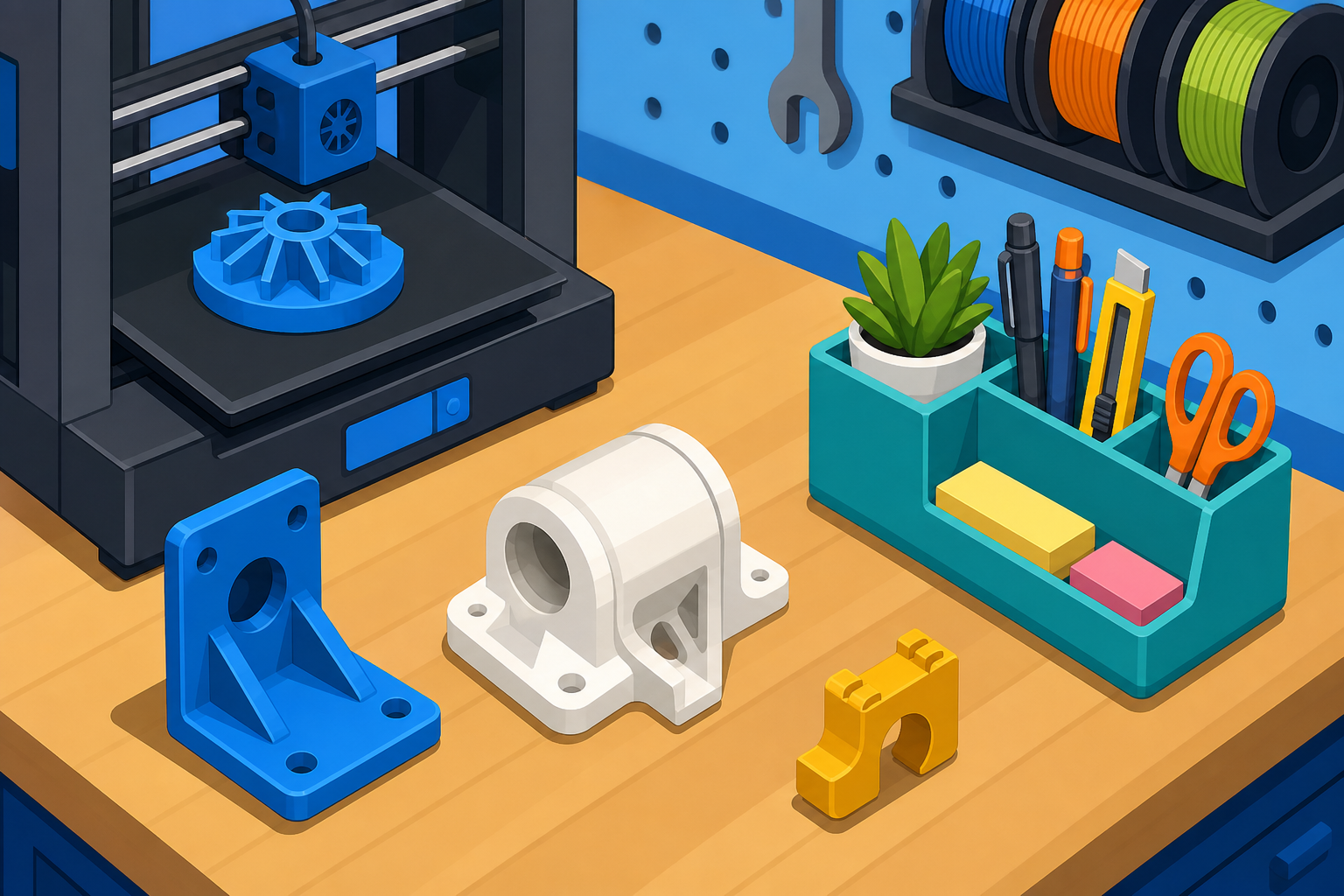
3D printing still gets treated like a novelty by a lot of people, but the real value is much more practical. It is not just for toys, gimmicks, or hobby projects. Used properly, 3D printing is a fast way to make custom parts, replacements, prototypes, and one-off solutions that would otherwise be awkward, expensive, or impossible to source.
If you have ever thought, “That would be handy if it existed,” there is a good chance 3D printing can help.
Everyday household fixes
One of the best uses for 3D printing is replacing small plastic parts that break long before the rest of the item wears out. A cracked bracket, a missing clip, a broken handle insert, or an awkward mount can make something useful feel disposable.
Instead of replacing the whole product, a custom printed part can often get it working again. This is especially useful when:
- the original spare part is no longer sold
- the part was badly designed in the first place
- a small replacement is hard to justify ordering from overseas
- the item is still good apart from one failure point
This makes 3D printing a practical option for repairs, upgrades, and extending the life of things you already own.
Custom parts that do not exist off the shelf
Not every problem has a ready-made solution. Sometimes you need a part that fits a very specific space, tool, machine, or workflow. That is where 3D printing becomes genuinely useful.
Examples include:
- cable guides and desk organisers
- brackets and mounting points
- adapters between two mismatched parts
- holders for tools, remotes, sensors, or equipment
- replacement knobs, caps, clips, or spacers
This is where custom printing beats buying off the shelf. Instead of searching for something close enough, you can create something that is actually right for the job.
Prototypes for product ideas
3D printing is also a strong fit for early product development. If you have an idea for a part or product, printing a prototype lets you test size, shape, fit, and usability before spending more money on tooling or manufacturing.
That matters because ideas usually improve once they become physical. A prototype helps answer questions quickly:
- Does it fit properly?
- Is it comfortable to hold?
- Is the wall thickness strong enough?
- Does the mechanism move the way it should?
- What needs changing before the next version?
For startups, side projects, and inventors, that speed is often the difference between an idea staying theoretical and becoming something real.
Small-batch custom jobs
Not everything needs to be mass-produced. Sometimes you only need one item, or maybe five, or maybe twenty. Traditional manufacturing is rarely friendly to those quantities, but 3D printing is.
That makes it ideal for:
- test batches
- custom accessories
- personalised parts
- jigs and fixtures
- hobby and maker projects
- low-volume business tools
If you need flexibility more than scale, 3D printing is often the better route.
Creative and gift projects
There is also a creative side to it. 3D printing can be used for personalised gifts, display pieces, branded items, miniatures, props, and novelty ideas. These are the projects people notice first, but they are only one part of the picture.
The better opportunity is when creativity and usefulness overlap. A printed item that looks good and solves a real problem is much more valuable than a gimmick.
When 3D printing is the right choice
3D printing is best when you need something that is:
- custom
- hard to source
- low-volume
- fast to prototype
- awkward to replace any other way
It is not the perfect solution for every job, but it is an excellent one when flexibility matters more than mass production.
Final thoughts
The biggest misconception about 3D printing is that it is mainly for people who already own a printer. In reality, a lot of the value comes from helping people solve small but annoying problems, create useful one-offs, and test ideas quickly.
That is where it becomes genuinely practical.
If you have a broken part, a custom idea, or something that almost exists but not quite, 3D printing may be the simplest way to make it real.
Need a replacement part, prototype, or custom print? Send over a photo, sketch, or description and we will let you know what is possible.
