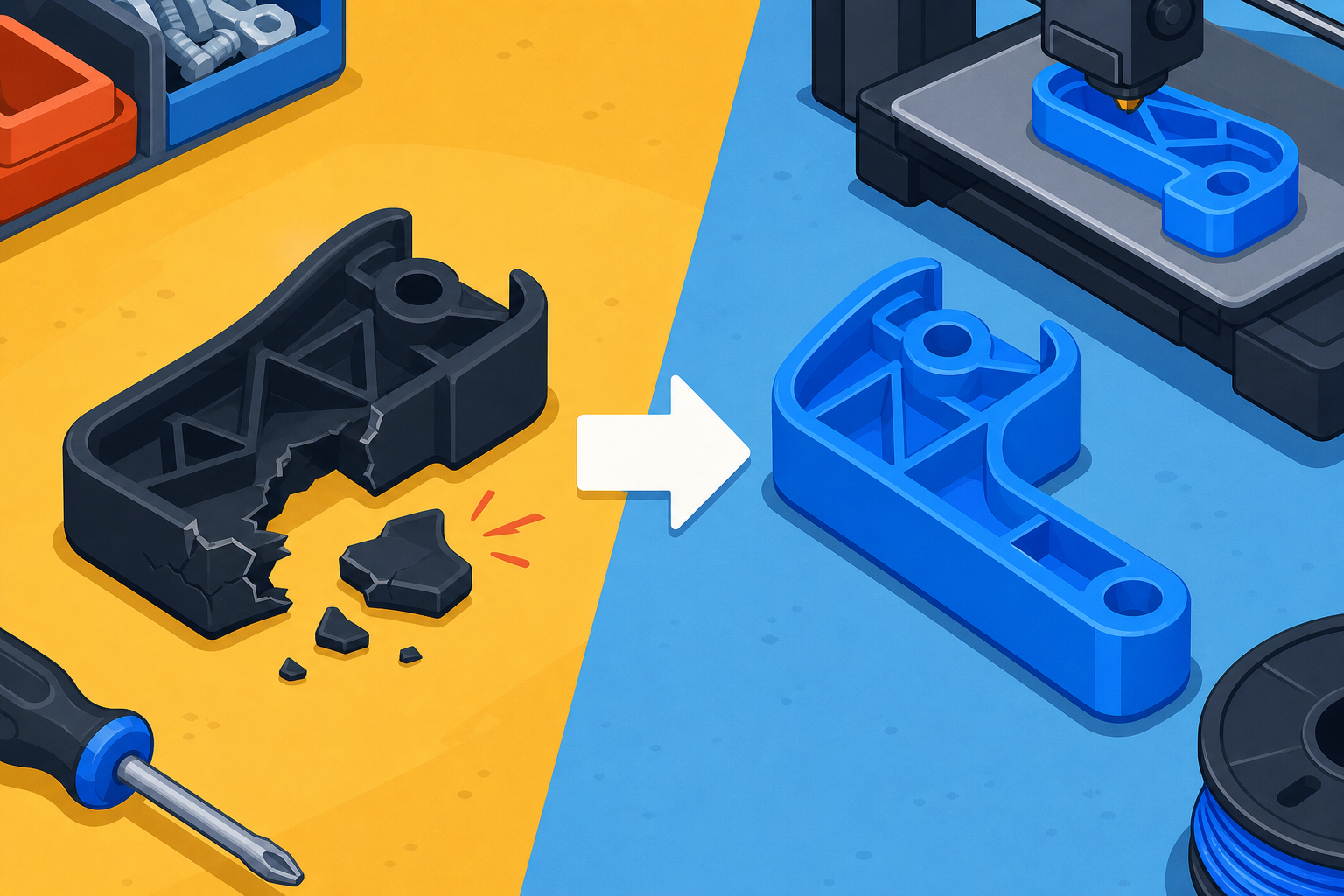
Broken Plastic Part? When to Replace It With a Custom 3D Print
A broken plastic part does not always mean replacing the whole product. In many cases, a custom 3D print is a practical way to get something working again, especially when the failed piece is small, awkward to source, or no longer sold.
For repairs, the real question is not whether a part can be printed. It is whether a printed replacement makes sense for the job. When it does, it can save time, reduce waste, and avoid the hassle of replacing something larger than necessary.
When a custom 3D printed replacement part makes sense
A custom 3D printed replacement part is often worth considering when:
- the original plastic part is cracked, missing, or worn out
- the product still works apart from that one failed component
- the original spare is discontinued or hard to find
- an off-the-shelf substitute does not fit properly
- you only need one part or a very small batch
This kind of repair can work well for clips, knobs, covers, brackets, spacers, holders, guides, and other non-critical components.
Common examples of parts that are good candidates
Some of the most practical repair jobs involve simple but annoying failures, such as:
- broken battery covers
- snapped clips or tabs
- missing knobs or handles
- cracked mounting brackets
- cable guides and holders
- small plastic spacers or adaptors
These are often the exact parts that make an item awkward or impossible to use, even though the rest of it is still fine.
When replacing the part is better than replacing the product
Replacing one plastic part usually makes more sense when the main item is still in good condition and the broken component is not safety-critical. That can apply to household items, workshop accessories, appliance fittings, enclosures, tool organisers, and small business equipment.
It is also a strong option when the original manufacturer no longer supports the product. A printed replacement can extend the useful life of something that would otherwise end up unused over one small failure.
For a broader look at repairability and why small replacement parts matter, iFixit has a useful guide to Right to Repair.
When a custom 3D print is not the right fix
Not every broken part should be reproduced in plastic. A custom 3D print is usually not the right choice if the part is:
- heavily load-bearing
- exposed to high heat without the right material choice
- safety-critical
- part of a certified system where failure could cause damage or injury
In those cases, a proper OEM replacement or a different manufacturing method may be the better route.
What helps us make a good replacement
The easiest repair jobs usually start with one of these:
- the broken original part
- a clear photo from several angles
- basic measurements
- the place where the part fits
From there, the part can be recreated, adjusted for fit if needed, and printed in a material that suits the job better.
Why custom repair prints are useful
The practical value is straightforward. Instead of throwing out a larger item because of one failed piece, you get a part that fits the actual problem. That is often faster than hunting down a rare spare and more sensible than buying a full replacement.
For one-off fixes, this is where 3D printing is especially useful. It allows a repair to be based on the real object in front of you rather than whatever generic replacement happens to be available online.
Final thoughts
If the broken piece is plastic, non-critical, and hard to replace, a custom 3D print is often worth considering. It can be a practical way to get an item working again without replacing more than necessary.
If you have a broken plastic part and want to know whether it can be reproduced, send over a photo, sketch, or the original piece and we will let you know what is possible.
