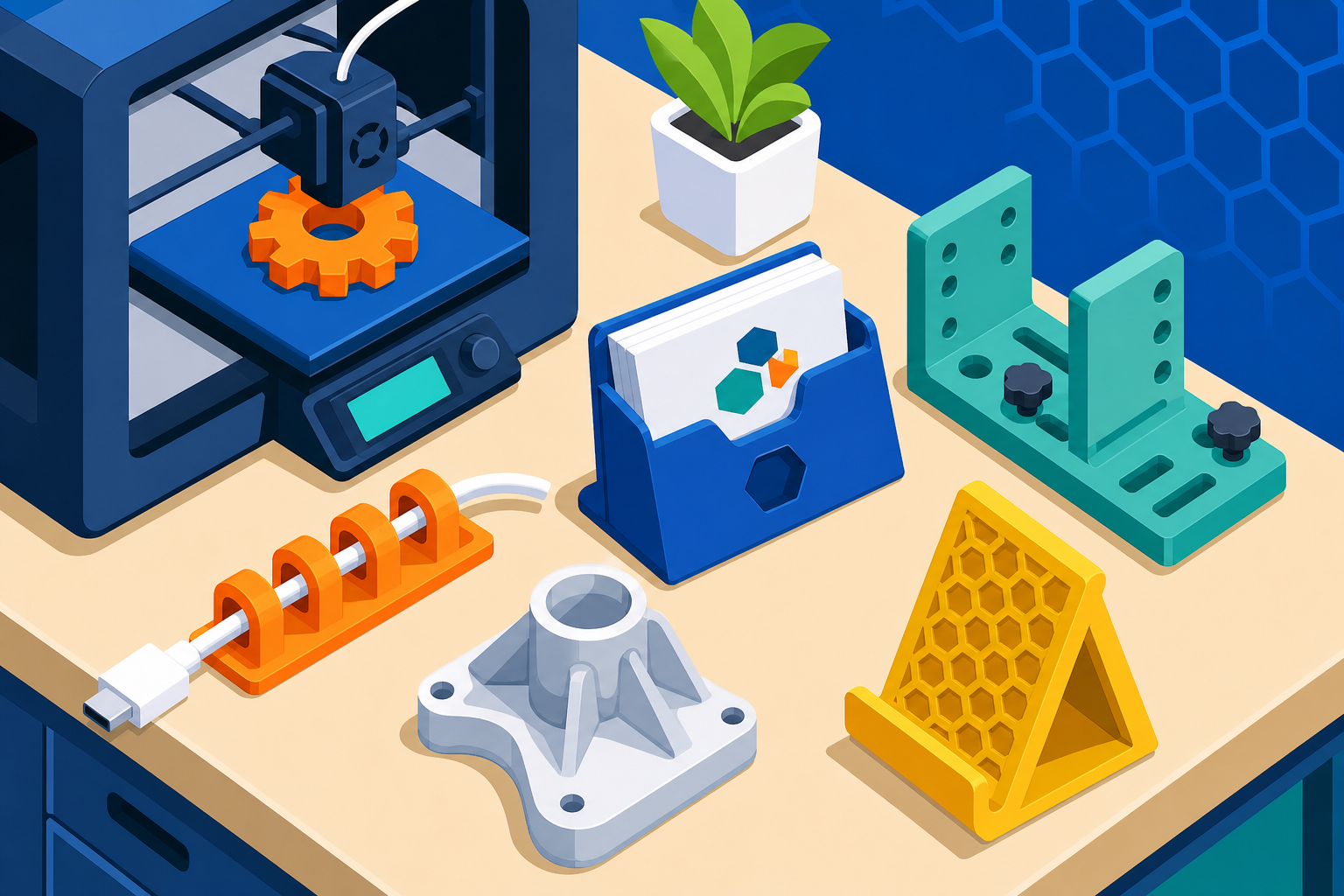
3D printing for local businesses is one of the most practical uses of modern fabrication. While many people still associate 3D printing with hobby projects or consumer products, local companies can use it to solve real day-to-day problems quickly and affordably.
For small companies, workshops, retail spaces, trades, and service businesses, 3D printing can solve practical problems quickly without the cost or delay of traditional manufacturing. It is especially useful when a business needs a custom part, a low-volume solution, or a quick prototype.
Here are some of the most practical ways local businesses can use 3D printing.
Why 3D Printing for Local Businesses Works So Well
The biggest advantage of 3D printing for local businesses is flexibility. Instead of waiting on long lead times or settling for a part that is only close enough, a business can get something made for the exact job, the exact space, or the exact workflow.
Custom brackets, holders, and mounts
Businesses often need simple parts that fit a very specific space or workflow. This could be a wall mount, a cable guide, a scanner holder, a tablet bracket, a tool hanger, or a custom fixture for equipment.
These parts are usually too specific to buy off the shelf, and having them made traditionally can be slow or expensive. 3D printing is a strong fit because it allows you to create a part for the exact job instead of trying to adapt something that was designed for a different use.
Jigs and fixtures for repeatable work
If a team performs the same task regularly, even a simple jig can save time and reduce mistakes. This is useful in workshops, assembly work, packing stations, maintenance environments, and small production setups.
3D printed jigs and fixtures can help with:
- positioning parts consistently
- speeding up repetitive tasks
- reducing human error
- making manual processes easier to follow
These are not glamorous jobs, but they are often where 3D printing delivers some of the clearest business value.
Replacement parts that keep equipment working
Downtime is expensive, especially when a machine or tool is held up by one small plastic component. If a non-critical part breaks, 3D printing can sometimes provide a practical replacement much faster than waiting for a supplier.
This is useful for:
- covers
- clips
- handles
- knobs
- spacers
- guides
Not every replacement part should be printed, especially if it is load-bearing or safety-critical, but for the right component it can be a fast and effective way to keep operations moving.
Prototypes for new products or internal improvements
Businesses do not need to be tech startups to benefit from prototyping. If you have an idea for a new product, an improved part, or a better tool for internal use, a quick printed prototype lets you test it before committing more money.
A prototype can help answer practical questions early:
- Does it fit the intended space?
- Is it the right size and shape?
- Is it easy for staff or customers to use?
- What should be changed before the next version?
That kind of fast iteration is often the real advantage.
For a broader look at rapid prototyping in business, see Formlabs’ guide to rapid prototyping.
Retail and display helpers
Shops, showrooms, and event spaces often need custom display parts that are hard to source in the exact size or style required. 3D printing can be used for:
- product stands
- signage holders
- custom business card holders for a sales desk
- shelf accessories
- branded display pieces
- cable management for neat presentation
These small details can improve how a space looks and functions without requiring a large production run.
A good example is a custom business card holder for a reception desk, sales counter, or showroom table. It can be shaped to fit the space properly, match the brand better than a generic holder, and act as a small visual prompt that encourages people to pick up a card rather than overlook it.
Low-volume custom parts
Some business needs sit in an awkward middle ground. You may not need mass manufacturing, but you do need more than one item. That could mean a few branded holders, a batch of custom spacers, or a set of small accessories for internal use.
This is where 3D printing works well. It allows for flexible small-batch production without the setup costs that usually come with more traditional manufacturing methods.
Faster problem solving
One of the biggest advantages of 3D printing for business is speed. A lot of operational problems are small, specific, and annoying rather than dramatic. A missing bracket, an awkward cable route, a poor tool layout, or a broken plastic fitting can waste time every day.
3D printing makes it easier to solve those problems with something purpose-built instead of relying on temporary workarounds.
Final thoughts
For local businesses, 3D printing is not just about making objects. It is about removing friction, solving practical problems, and improving the way work gets done.
It can help with repairs, custom tools, small-batch parts, prototypes, and workspace improvements in a way that is fast and flexible.
If your business has a part, process, or problem that would benefit from a custom solution, 3D printing is often worth considering.
Need a custom part, fixture, or small-batch business solution? Send over a photo, sketch, or description and we will let you know what is possible.
