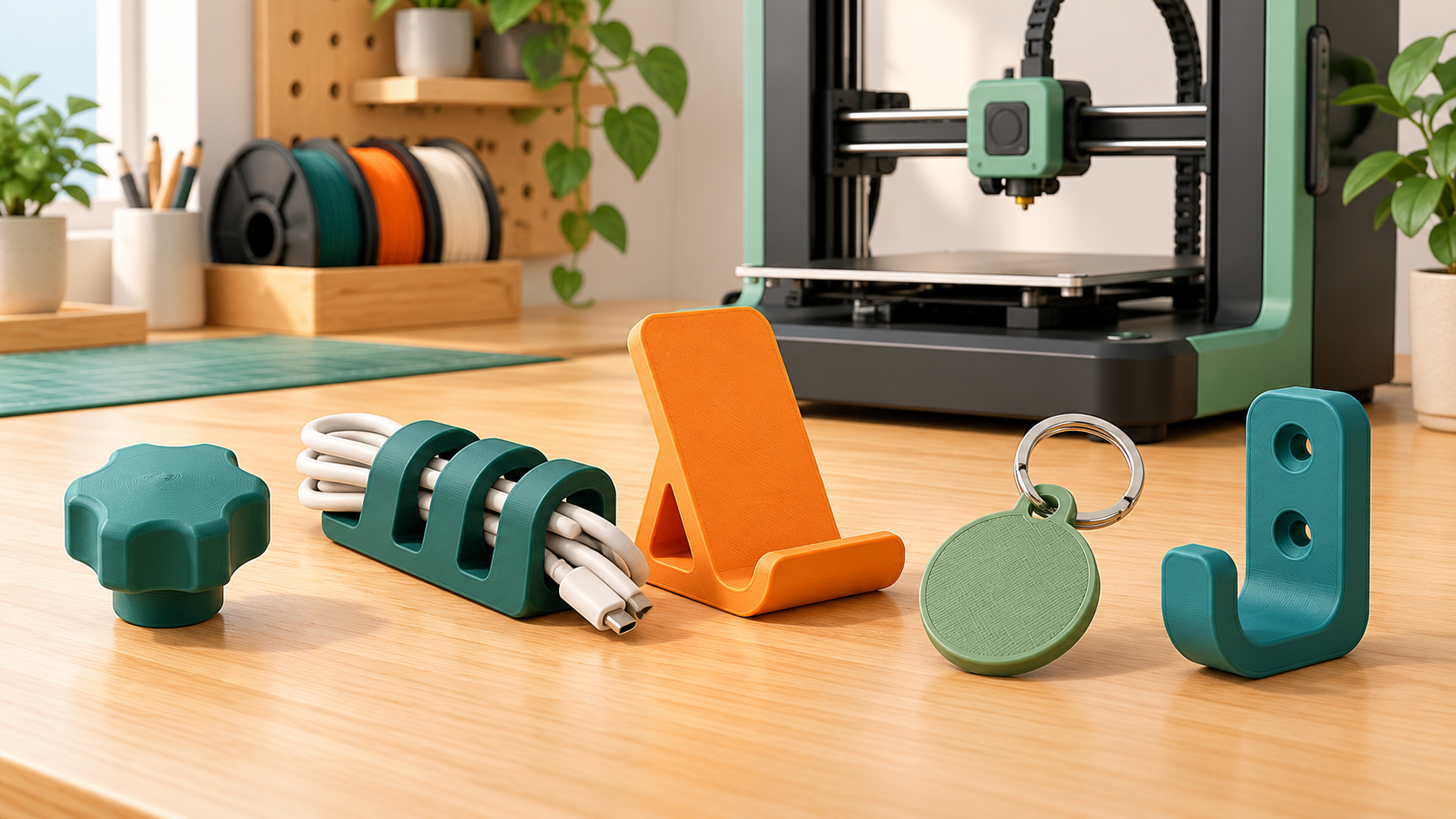
Choosing your first 3D printing project can feel harder than it should. There are thousands of possible designs, but the best place to start is usually with something small, useful, and easy to describe.
These five first 3D printing projects are practical enough to use every day and simple enough to turn into a clear brief. You do not need a finished CAD file either—a photo, sketch, measurements, or a description of the problem can be enough to begin.
What makes a good first 3D printing project?
A strong first project normally has a clear purpose, a manageable size, and only a few important measurements. It should solve one specific problem rather than trying to do everything at once.
Good starting projects are often:
- small enough to prototype without using too much material
- easy to measure or photograph
- useful even in a simple first version
- straightforward to adjust after a test print
Here are five reliable ideas.
1. A replacement knob or handle
A missing knob can make an otherwise useful drawer, cabinet, tool, or appliance awkward to use. If the original is unavailable or the nearest shop-bought replacement does not fit, a custom 3D printed version may be a practical option.
To get started, share a photo of the item, the diameter or dimensions of the fitting, and any broken original part you still have. The new design can be shaped for a comfortable grip and adjusted to match the attachment point.
This is a particularly good first project because the function is clear: it needs to fit securely and feel comfortable in use.
2. A cable organiser for your desk
Phone chargers, USB leads, and laptop cables have a habit of slipping behind a desk. A small cable organiser can keep them separated and within reach.
Useful details include the number of cables, their approximate thickness, and where the organiser will sit. It could be a freestanding holder, a clip for a desk edge, or a small guide fixed with suitable adhesive.
Because the design is compact, it is easy to test and refine if a slot needs to be slightly wider or the base needs more stability.
3. A phone or tablet stand
A simple stand is useful for video calls, recipes, reference material, or keeping a screen visible while you work. It can also be tailored to a particular device, case thickness, viewing angle, or charging-cable position.
For the first version, decide whether it should work in portrait, landscape, or both. Then provide the device width and thickness, including its case. A straightforward stand with a stable base is often more useful than an overcomplicated folding design.
4. A personalised keyring or tag
A keyring, luggage tag, equipment label, or bag tag is a simple way to try a personalised print. The shape, colour, hole size, and raised or recessed details can all be adapted without turning the project into a large production job.
This works well for a one-off item, a gift, or a small matching set. Keep the wording and fine details simple so they remain clear and durable at the finished size.
5. A small hook, bracket, or holder
Small holders are among the most useful first 3D printing projects because they solve very specific annoyances. You might need a hook for headphones, a bracket for a remote control, a holder for a hand tool, or a mount for a lightweight device.
The important questions are what the holder supports, how much weight it carries, and how it attaches. Photos of the location and a few measurements make it much easier to judge the right shape and material.
For anything safety-critical, heavily loaded, or exposed to significant heat, a different material or manufacturing method may be more appropriate. The intended use should always be clear before printing.
How to choose between the five ideas
Start with the problem you notice most often. A good first project is not necessarily the most impressive-looking one—it is the one you will actually use.
Ask yourself:
- What should the object do?
- Where will it be used?
- What size must it be?
- Does it need to fit another object?
- Will it face heat, moisture, weight, or repeated handling?
If you want inspiration before settling on a design, the community models on Printables can help show what is possible. A custom version can then be adapted to your measurements and use case rather than relying on a generic fit.
What to send for a first quote
You do not need technical drawings. Send whatever you have:
- a short description of the idea or problem
- photos from a few angles
- rough measurements
- a sketch showing the important features
- details about where and how the object will be used
That is usually enough to assess the project, identify any missing measurements, and suggest a sensible next step.
Start with one useful object
The best first print is often a modest object that fits properly and solves a real problem. A replacement knob, cable organiser, device stand, personalised tag, or small holder can all demonstrate what custom 3D printing does well without making the process complicated.
Have an idea for your first 3D printed project? Send Cork3D a photo, sketch, or short description and we will help you work out what is practical.
