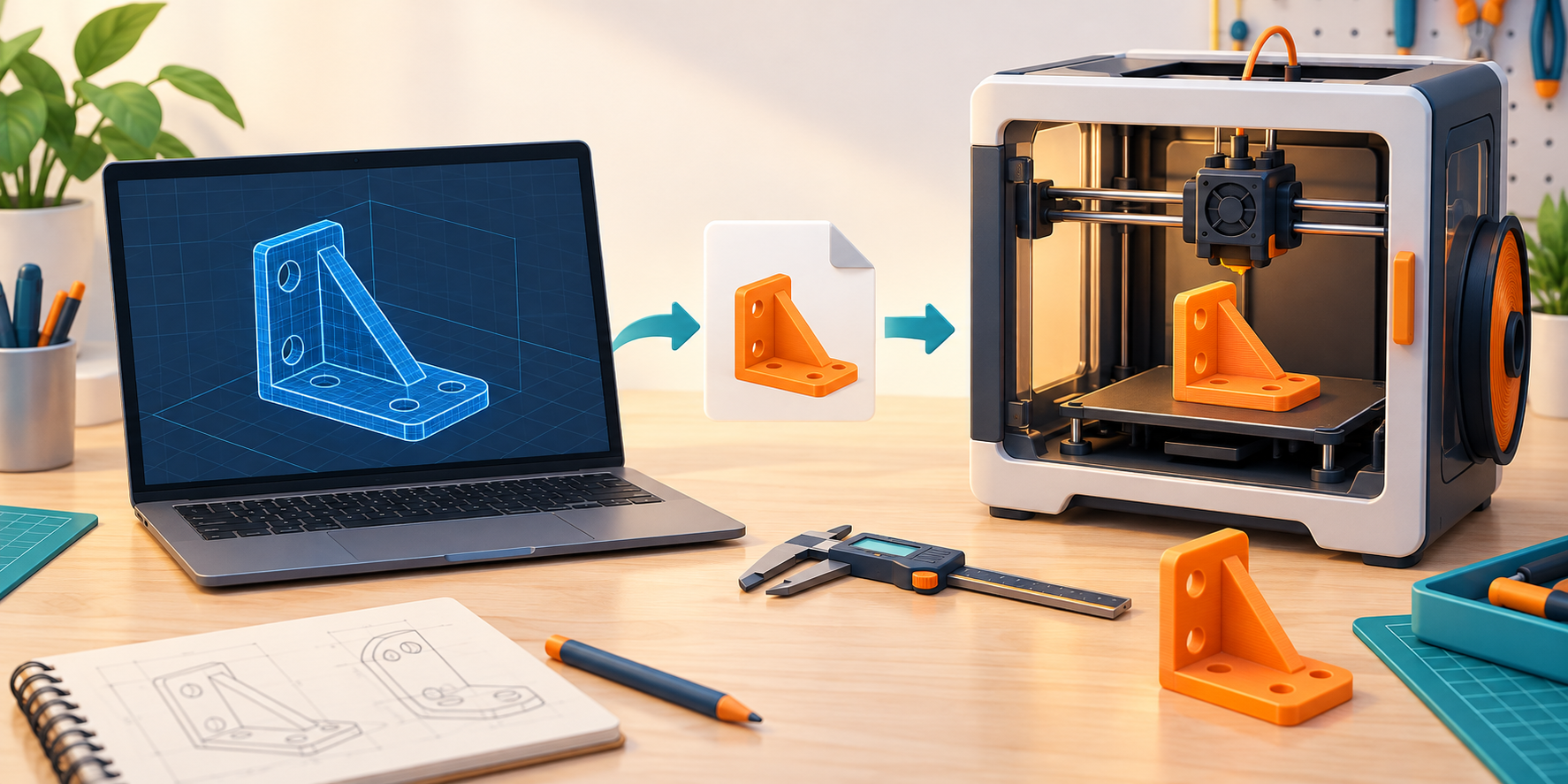
Having an idea for a 3D print and having a printable 3D file are two different stages of the job. A 3D printing service manufactures the object, but 3D design for 3D printing must first turn the idea, sketch, photo, or measurements into a digital model.
For customers who need that design stage completed, Fiverr is often a practical place to start. It has a large selection of freelancers offering CAD modelling, sculpting, STL creation, reverse engineering, and design-for-manufacture services. It is not the only option, however, and the right choice depends on what you need designed.
This guide explains when Fiverr makes sense, what alternatives are available, and exactly what to request before sending a file to Cork3D for printing.
Quick recommendation: For a straightforward one-off object, Fiverr is usually the easiest first option. For complex engineering work, ongoing collaboration, safety-critical parts, or products intended for manufacture, use a specialist CAD platform, experienced product designer, or qualified engineer.
Cork3D is not affiliated with Fiverr or the other services mentioned in this guide. Always review the current price, terms, intellectual-property rights, and licence before ordering.
Before hiring a designer, check whether the model already exists
Custom design may not be necessary. Search established 3D-model libraries such as Printables, MakerWorld, MyMiniFactory, and Cults3D first.
You may find the exact item or something close enough to use. Check:
- whether the download includes an STL or 3MF file
- the model dimensions and intended print process
- comments or photographs from people who have printed it
- whether the licence allows your intended personal or commercial use
- whether separate hardware, inserts, magnets, or assembly are required
If a suitable model already exists, obtaining the file is normally quicker and cheaper than commissioning a new design.
Choosing a 3D design service for 3D printing
For many one-off jobs, yes. Fiverr has a dedicated Industrial & Product Design category with freelancers offering 3D modelling, CAD, STL creation, design for manufacturing, and related services.
The main advantages are:
- a large choice of designers and price points
- portfolios, reviews, and seller history in one place
- defined packages and delivery times
- the ability to message a designer before ordering
- custom offers for jobs that do not fit a standard package
- a structured revision and delivery process
Fiverr also adds a service fee at checkout, so compare the final total rather than the advertised starting price. Its official client guide explains packages, custom offers, fees, delivery, and revisions.
The biggest risk is choosing somebody who can make an attractive render but does not understand 3D printing. A model can look perfect on screen while having walls that are too thin, disconnected geometry, impossible overhangs, incorrect scale, or clearances that will not work when printed.
Choose the right kind of 3D designer
“3D designer” covers several different skills. Match the freelancer to the job.
Mechanical parts, brackets, enclosures, and adapters
Look for a CAD or product designer with examples of functional parts. Experience with Fusion, SolidWorks, Onshape, Inventor, or similar parametric software is useful. Ask for an editable STEP or native CAD file as well as the printable mesh.
Figurines, miniatures, characters, and decorative objects
Look for a digital sculptor or character artist with 3D-printing experience. Blender and ZBrush are common tools. Confirm the intended finished size because very fine detail can disappear when a model is reduced.
Replacement parts copied from an existing object
Look for somebody offering reverse engineering from measurements, photographs, or a scan. Accurate dimensions matter more than visual similarity. Complex mating surfaces may require callipers, test prints, and more than one revision.
Logos, signs, nameplates, and simple personalised items
A general 3D modeller may be enough, but supply a clean vector logo where possible and confirm the overall dimensions, raised or recessed detail, mounting method, and intended orientation.
What to send in your design brief
A clear brief produces better quotations and fewer revisions. Copy this checklist into your message:
- Purpose: What should the object do?
- Overall dimensions: Width, height, and depth in millimetres.
- Critical measurements: Hole spacing, shaft diameter, clearances, wall thickness, or mating surfaces.
- Reference material: Sketches, photographs from several angles, existing parts, logos, or examples.
- Use conditions: Indoor or outdoor use, heat, moisture, load, repeated movement, or food contact.
- Print process: State that the model is intended for 3D printing, usually FDM unless agreed otherwise.
- Assembly: Screws, magnets, inserts, clips, glue, or separate moving parts.
- Finished quantity: One prototype or a repeatable small batch.
- Licence and ownership: Personal use, commercial use, and whether editable source files are required.
- Deadline: Include time for review, revisions, and a possible test print.
Do not rely on a photograph alone when fit matters. Include measurements and identify which dimensions are critical.
Deliverables to request from the designer
Before ordering, agree what files will be delivered. For most projects, request:
- STL or 3MF for printing
- STEP for a mechanical or parametric part
- the native editable source file where future changes may be needed
- correct scale in millimetres
- a watertight, manifold model without disconnected geometry
- separate files for parts that must be printed or assembled separately
- confirmation that wall thicknesses and clearances suit the intended print process
- the agreed personal or commercial usage rights in writing
An STL is useful for printing but awkward to edit. Keeping a STEP or native CAD file can save the cost of recreating the design when one dimension needs to change later.
Fiverr compared with the alternatives
Fiverr
Best for straightforward one-off models with a clear brief. Fiverr offers a large marketplace, visible packages, reviews, and quick custom offers. Skill varies, so verify genuine 3D-printing experience and the exact deliverables before ordering.
Upwork
Best for larger, evolving, or ongoing projects. Upwork lets you post a job, review proposals, interview candidates, and continue with hourly or milestone work. It usually takes more effort to write the job and compare proposals.
Cad Crowd
Best for technical CAD, product design, engineering, or managed matching. Cad Crowd focuses on CAD talent, private projects, contests, and managed services. It is generally more appropriate for a serious design budget than a small novelty job.
Local CAD designer or engineer
Best for parts needing measurement, site visits, confidentiality, or close collaboration. The main advantage is direct communication and the possibility of inspecting the original object. Availability and cost vary, so ask about specific 3D-printing experience.
Existing model library
Best for common objects, hobby items, accessories, and proven community designs. This is normally the fastest and cheapest option. Check licences, dimensions, print history, and whether modification is allowed.
Our overall recommendation is to use Fiverr first for a well-defined, non-critical one-off model. Use Upwork when the scope is likely to evolve or you want an ongoing working relationship. Use Cad Crowd, a product designer, or a qualified engineer where accuracy, engineering judgement, documentation, safety, or manufacturing readiness matters.
Questions to ask before placing an order
Send these questions to a shortlisted designer:
- Have you designed parts specifically for FDM or resin printing?
- Can you show a similar model that was successfully printed?
- Will the delivered model be watertight and correctly scaled?
- Are STL or 3MF, STEP, and editable source files included?
- How many revisions are included?
- Will you design the required tolerances and clearances, or should I provide them?
- Who owns the completed design, and may I print it commercially?
- Can you revise the design after a physical test print if the fit needs adjustment?
Confirm those answers inside the platform before paying. Do not assume that “3D model” automatically means “ready for 3D printing.”
Allow for a test print
Even a good digital model may need one physical iteration. Printer tolerances, material shrinkage, orientation, and the accuracy of the original measurements can affect fit.
For clips, covers, brackets, adapters, and replacement parts, plan for a low-cost test print before ordering the final colour, material, or quantity. Ask the designer whether one fit-adjustment revision is included after testing.
What Cork3D needs from you
Cork3D focuses on turning print-ready files into physical parts. We can review a supplied model for basic printability, discuss material and orientation, and quote for prototypes or small batches. Full CAD design, detailed reverse engineering, and open-ended product development should be completed with a suitable designer before requesting a print quote.
When contacting us, send:
- the STL, 3MF, or suitable model file
- the required finished quantity
- the intended use of the part
- your preferred material or the conditions it must withstand
- any critical dimensions or surfaces
- your preferred colour and deadline
If the file needs significant redesign, we will ask you to return to the designer rather than quietly changing the geometry and risking a result you did not approve.
Design first, then print with confidence
Fiverr can be a good, accessible route from idea to printable model when the brief is clear and the freelancer has genuine 3D-printing experience. The platform is particularly useful for straightforward one-off designs, while Upwork, Cad Crowd, and local specialists provide stronger options for involved or technical projects.
Once the design is complete, send the print-ready file to Cork3D. We can assess the manufacturing side, recommend an appropriate material, and provide a quote for the physical print.
